

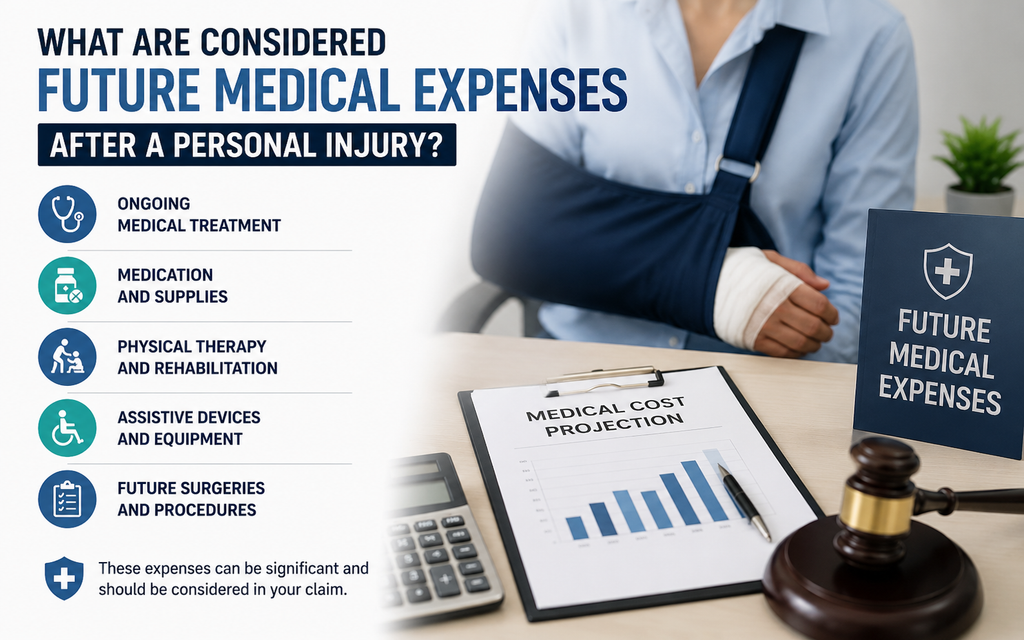
A serious injury does not always stop creating expenses when the initial hospital bills are paid. Some people require additional surgeries, ongoing physical therapy, prescription medications, specialist appointments, medical equipment, or assistance with everyday activities months or even years after an accident.
These anticipated costs are commonly referred to as future medical expenses.
Future medical expenses are the estimated costs of reasonable and necessary medical care an injured person is expected to need after a personal injury claim is resolved. Unlike past medical expenses, which reflect treatment that has already occurred, future medical expenses attempt to account for healthcare and related needs that have not yet been incurred.
Depending on the severity and permanence of the injury, those expenses can represent a significant part of a personal injury claim.
What Are Future Medical Expenses?
Future medical expenses generally include reasonably anticipated healthcare costs resulting from the injury.
For someone expected to make a full recovery within several months, future costs might consist of a limited period of additional physical therapy and follow-up appointments.
For someone with a spinal cord injury, traumatic brain injury, amputation, severe orthopedic injury, or other permanent impairment, however, future medical needs could continue for decades or for the remainder of the person’s life.
The goal is to estimate what medical care and support the individual will reasonably require because of the accident – not merely what treatment has already been received.
What Types of Costs Can Be Considered Future Medical Expenses?
The exact expenses depend on the person’s diagnosis, prognosis, age, physical limitations, and expected course of treatment.
Common examples include:
Future Surgeries and Medical Procedures
Some injuries cannot be fully treated immediately.
An orthopedic injury, for example, could require surgery later if conservative treatment fails or if the person’s condition worsens. Other patients may eventually require hardware removal, joint replacement, spinal procedures, reconstructive surgery, or additional corrective procedures.
Projected costs may extend beyond the surgeon’s fee and include expenses such as:
- Hospital or surgical-facility charges
- Anesthesia
- Diagnostic imaging
- Laboratory testing
- Postoperative care
- Follow-up visits
- Rehabilitation following surgery
When a doctor believes additional surgery is likely, the expected cost of that procedure may become an important part of evaluating future damages.
Physical, Occupational and Speech Therapy
Rehabilitation may continue long after an injured person leaves the hospital.
Future medical expenses can include anticipated:
- Physical therapy
- Occupational therapy
- Speech and language therapy
- Cognitive rehabilitation
- Neurological rehabilitation
- Inpatient or outpatient rehabilitation
The duration and frequency of therapy can significantly affect the projected cost, particularly when treatment will be required for years. Long-term rehabilitation is frequently among the types of future care considered in serious injury cases.
Prescription Medications
Chronic injuries can require ongoing medication for pain, inflammation, muscle spasms, nerve symptoms, psychological effects, seizure prevention, or other accident-related conditions.
When medication is expected to continue into the future, projections may consider both the cost of the prescription and how frequently it will need to be filled.
Pain Management
Some injuries result in chronic pain that cannot be completely eliminated through surgery or rehabilitation.
Future treatment could involve:
- Pain-management appointments
- Prescription medication
- Injections
- Nerve blocks
- Radiofrequency procedures
- Other interventional treatments
Long-term pain management is one example of a future expense that may need to be considered when evaluating the financial consequences of an injury.
Specialist and Follow-Up Appointments
Even after active treatment ends, an injured person may need ongoing monitoring.
Future medical care can include recurring appointments with physicians such as:
- Orthopedic surgeons
- Neurologists
- Neurosurgeons
- Pain-management specialists
- Psychiatrists or psychologists
- Physical medicine and rehabilitation specialists
- Other appropriate specialists
Specialist follow-up can be particularly important when an injury creates a risk of degenerative changes or other long-term complications.
Diagnostic Testing and Imaging
Certain injuries require periodic testing to monitor the patient’s condition.
Depending on the medical issues involved, future expenses might include:
- X-rays
- MRIs
- CT scans
- Blood tests
- Nerve-conduction studies
- Other diagnostic procedures
These expenses may recur at different intervals over the patient’s lifetime.
Medical Equipment and Assistive Devices
People with significant disabilities may require equipment that improves mobility, safety, independence, or their ability to perform everyday activities.
Examples can include:
- Wheelchairs
- Walkers
- Canes
- Prosthetic limbs
- Orthopedic braces
- Shower or bathroom equipment
- Hospital beds
- Patient lifts
- Communication devices
- Other assistive technology
An important part of estimating these expenses is considering replacement costs. A person who will need a wheelchair for decades, for example, may need multiple replacement chairs rather than a single purchase. Catastrophic-injury projections may therefore account for equipment and related support over the person’s expected lifetime.
In-Home Medical Care and Personal Assistance
Some injuries prevent a person from safely living independently without additional support.
Future care could include:
- Home health aides
- Skilled nursing care
- Personal-care attendants
- Medication assistance
- Help with bathing or dressing
- Assistance transferring in and out of a wheelchair or bed
The amount and type of assistance required can range from several hours per week to around-the-clock care in the most severe cases. In-home care is among the expenses commonly considered when long-term medical needs are projected.
Psychological and Mental Health Treatment
Physical trauma can sometimes create ongoing psychological or emotional treatment needs.
When medically appropriate and related to the accident, future care could include counseling, psychological treatment, psychiatric appointments, or medication.
Long-Term and Residential Care
Individuals with profound disabilities may eventually require:
- Assisted living
- Skilled nursing facilities
- Long-term rehabilitation facilities
- Specialized residential care
These expenses can become particularly significant when care is expected to continue for many years.
Can Home and Vehicle Modifications Be Included?
Severe disabilities sometimes require changes to a person’s living environment or transportation.
Examples can include wheelchair ramps, wider doorways, accessible bathrooms, stair lifts, roll-in showers, lowered countertops, vehicle lifts, hand controls, or other accessibility features.
Whether these costs are legally categorized as “medical expenses” or another type of economic damage depends on the jurisdiction and circumstances. However, life-care planning for catastrophic injuries may evaluate equipment, support services and related accommodations necessary for an injured person’s future functioning.
For that reason, a comprehensive analysis of an injured person’s future needs may extend beyond traditional doctor and hospital bills.
How Are Future Medical Expenses Different From Past Medical Expenses?
The distinction is relatively straightforward:
Past medical expenses are costs that have already been incurred.
They might include:
- Ambulance bills
- Emergency room treatment
- Hospitalization
- Surgery already performed
- Doctor visits
- Diagnostic imaging
- Physical therapy already completed
- Prescriptions already purchased
Future medical expenses, by comparison, involve care that is expected to occur after the claim is evaluated or resolved.
That distinction can make future expenses more complicated to establish. A hospital bill shows exactly what past treatment cost. Future treatment has not happened yet, so its necessity, frequency, duration and cost must be reasonably projected based on available evidence.
How Are Future Medical Expenses Calculated?
There is no single formula that applies to every injury.
Calculating future costs typically begins with medical evidence identifying what treatment the patient is likely to require. Physicians and other medical professionals may evaluate the person’s diagnosis, prognosis, limitations, expected recovery, future complications and recommended treatment.
Depending on the complexity of the case, the analysis may consider factors such as:
- The type and severity of the injury
- Whether the condition is permanent
- The patient’s current age
- Expected recovery
- The likelihood of future complications
- Recommended surgeries
- Frequency of medical appointments
- Duration of therapy
- Medication needs
- Equipment replacement schedules
- Long-term care requirements
- Expected medical costs
The farther into the future the care extends, the more complex these projections may become.
Why Medical Documentation Is So Important
Future medical expenses generally cannot be based solely on an injured person’s belief that treatment might eventually be necessary.
Medical documentation can help establish both the necessity of future care and the anticipated course of treatment. Prognosis reports, treatment recommendations and impairment evaluations can provide evidence regarding a patient’s expected future needs.
For example, an orthopedic surgeon might explain that a patient will probably require a joint replacement because an accident caused severe post-traumatic degeneration. A rehabilitation specialist might outline several years of therapy. Another medical provider might document the need for ongoing pain-management treatment.
The stronger the connection between the injury, medical prognosis and anticipated treatment, the more clearly future expenses can be evaluated.
What Is a Life-Care Plan?
In cases involving catastrophic or permanent injuries, the person’s anticipated needs may be documented in a life-care plan.
A life-care plan is a detailed projection of the medical treatment, therapy, equipment, services and related support an injured person is expected to require in the future. These plans are particularly useful when care will continue over many years and involve multiple providers, treatments and replacement schedules.
Depending on the individual’s condition, a life-care plan may address:
- Physician appointments
- Future surgeries
- Rehabilitation
- Prescription medications
- Diagnostic testing
- Medical supplies
- Mobility equipment
- Assistive technology
- Home healthcare
- Long-term care
- Equipment replacement
Rather than estimating future medical expenses as one broad number, a life-care plan can itemize individual needs, how often they are expected to occur and how long they may continue.
Do Future Medical Costs Need to Be Certain?
Predicting the future always involves some degree of uncertainty.
An injured person generally cannot know with absolute certainty whether a particular procedure will occur 10 or 20 years from now. For that reason, future medical expenses are usually supported through medical opinions and objective evidence showing that the anticipated treatment is reasonably expected rather than merely speculative.
The required legal standard varies by jurisdiction, which is one reason medical evidence and appropriate expert analysis can become important when substantial future costs are claimed.
Why Reaching Maximum Medical Improvement Can Matter
Another important consideration is the injured person’s stage of recovery.
Maximum medical improvement, commonly called MMI, generally describes the point at which a person’s condition has stabilized and further substantial improvement may not be expected, even though ongoing treatment may still be necessary.
Resolving a claim while the medical outlook remains uncertain can make future costs harder to identify. SeriousAccidents.com notes that settlement decisions should consider whether the claimant has reached maximum medical improvement, particularly when the prognosis and future treatment needs are still unclear.
For example, a person who is only two months into treatment may not yet know whether physical therapy will resolve an injury or whether surgery will eventually become necessary.
Why Future Medical Expenses Matter When Evaluating a Settlement
A personal injury settlement generally ends the claim against the settling party once an appropriate release is signed. That means an injured person typically cannot return later and seek additional money simply because medical care turned out to be more expensive than anticipated.
That makes the evaluation of future needs especially important.
Consider an injured person who currently has $40,000 in medical bills but is also expected to undergo another surgery, complete additional rehabilitation and receive years of follow-up treatment. Looking only at the bills already incurred would provide an incomplete picture of the accident’s medical consequences.
A meaningful evaluation of damages therefore considers not only what the injury has already cost, but what it is reasonably expected to cost in the future.
Future Medical Expenses Are Only One Type of Personal Injury Damage
Future medical expenses should also be distinguished from other accident-related losses.
Depending on the case and applicable law, a personal injury claim may involve damages such as:
- Past medical expenses
- Future medical expenses
- Past lost wages
- Reduced future earning capacity
- Pain and suffering
- Disability
- Disfigurement
- Emotional distress
- Loss of enjoyment of life
- Property damage
- Household-service losses
A life-care plan and medical-cost analysis primarily address healthcare and related future support. They do not necessarily capture every financial and personal consequence of a serious injury.
The Bottom Line: Future Medical Expenses Account for the Care an Injury May Require for Years to Come
Future medical expenses are the projected costs of reasonable and necessary medical care an injured person is expected to require after a personal injury claim concludes.
Depending on the injury, those expenses can include future surgery, physical therapy, medications, pain management, specialist appointments, diagnostic testing, medical equipment, in-home assistance and long-term care. For people with catastrophic or permanent injuries, some of those costs may continue for the rest of their lives.
Because these expenses have not yet occurred, calculating them requires looking beyond current medical bills. Medical records, physicians’ opinions, treatment recommendations, cost information and, in more complex cases, life-care plans can all help establish a clearer picture of what future care may involve.
Accurately identifying those needs is important because once a personal injury claim is finally settled, unexpected medical costs that arise years later may become the injured person’s responsibility.
This article provides general information about future medical expenses in personal injury claims and is not legal or medical advice. The damages available and the evidence required to establish them vary by jurisdiction and the facts of each case.
